Behavior Board
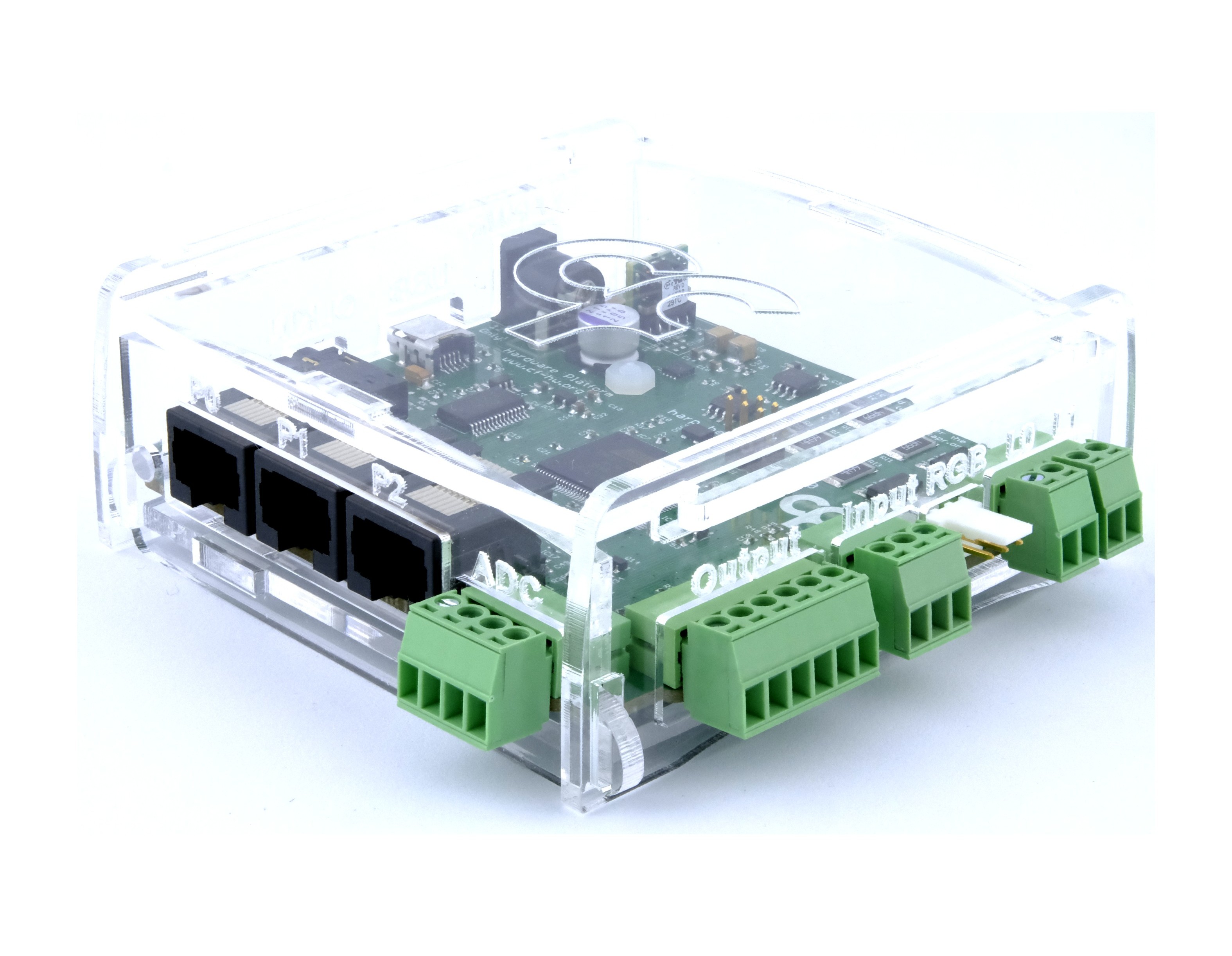
Key Features
- 3 peripheral ports for plug-and-play peripherals.
- Hardware-timed pulses for all digital outputs and PWM for the four digital outputs on the Output connector.
- Support for camera triggering, servo motor control, and quadrature encoder counting on selected digital outputs.
- Configurable LED drive current (up to 100 mA) and RGB LED driver.
Specs
- Analog inputs: 2 (0–5 V, 12-bit, sampled at 1 kHz)
- 1 on the ADC connector
- The second analog input on the Input connector is available on hardware v2.0 or later
- Digital inputs: 4 (5 V)
- 3 on the peripheral ports, accessible with the Breakout board
- The fourth digital input on the Input connector is available on hardware v2.0 or later
- Digital outputs: 7 (5 V)
- 4 on the Output connector
- 3 on the peripheral ports, accessible with the Breakout board
- Digital output pulse duration: 1–65535 ms (supported on all digital outputs)
- Digital output PWM: 1–10000 Hz, duty cycle 1–99% (supported on the Output connector only)
- Peripheral ports: 3 (RJ45)
- For the Mice Poke, Rotary Encoder, or Breakout board
- LED outputs: 2 (2–100 mA drive current)
- RGB LED outputs: 2 (WS2812-type addressable LED connector, driven as a serial chain)
- Camera triggers: 2 (DO0/DO1, 2–600 Hz)
- Servo outputs: 2 (DO2/DO3)
- Quadrature encoder inputs: 1 (P2, sampled at 1 kHz)
- Timestamp resolution: 32 µs
- Synchronization frequency: 1 Hz
- Synchronization accuracy: 22 ± 16 µs (between clock generator and this device)
Hardware
| Version | Notes |
|---|---|
| 2.1 |
|
| 2.0 |
|
| 1.1 |
|
Firmware
| Version | Notes |
|---|---|
| 3.3 |
|
| 3.2 |
|
| 3.1 |
|
| 3.0 |
|
Last updated with:
Hardware v2.1
Firmware v3.3
Bonsai Package v0.2